I used to think lighting was the last thing you worried about in a laundry room. Then I spent a winter doing laundry under a single bare bulb in a 1947 Buffalo basement and changed my mind completely.
Bad lighting does more than make the room feel gloomy. It hides the slow drip behind the washer. It makes stains harder to see so clothes go back into the dryer still dirty. It turns folding into a chore you rush through because the space feels like a punishment. And it reinforces the exact attitude that leads to neglected maintenance: if the room already feels miserable, why bother keeping it up?
Good lighting is one of the highest-return, lowest-cost upgrades you can make. It does not require a full renovation. It does require treating the laundry room like a workspace instead of a storage closet.
What One Bare Bulb Actually Costs You
Our starting point was a single porcelain socket with a 60-watt-equivalent LED hanging from the ceiling joist. When it was on, it cast a harsh pool of light directly under the machines and left the corners in shadow. When it burned out—which happened more often than it should have because of the cold and the vibration—we worked by the light from the stairwell.
In that light I missed a small weep at the shut-off valve for almost a week. I misjudged stain treatment more than once. I hated being in the room after dark, which meant evening loads sat wet longer than they should have. The moisture meter readings stayed higher than they needed to because the space never felt inviting enough to linger and notice problems.
One bare bulb is not neutral. It is actively working against you.
The Minimum That Actually Works
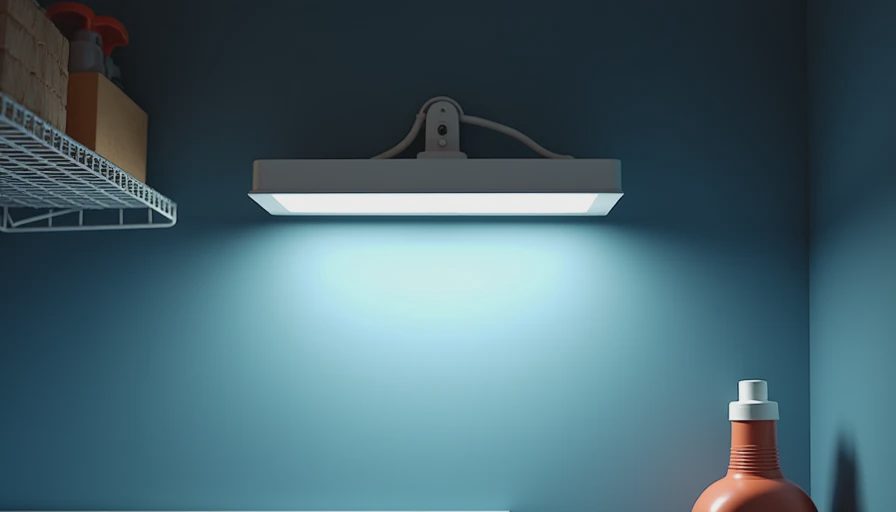
You need even, shadow-free light across the machines, the folding surface, and the floor. That usually means at least two sources, preferably three.
Ceiling fixtures are the foundation. Two simple LED flush-mounts or a single longer shop-light-style fixture centered over the work area will do more than any single decorative pendant. Add under-shelf or under-cabinet lighting if you have any overhead storage. A small wall sconce or a plug-in LED bar near the utility sink finishes the job.
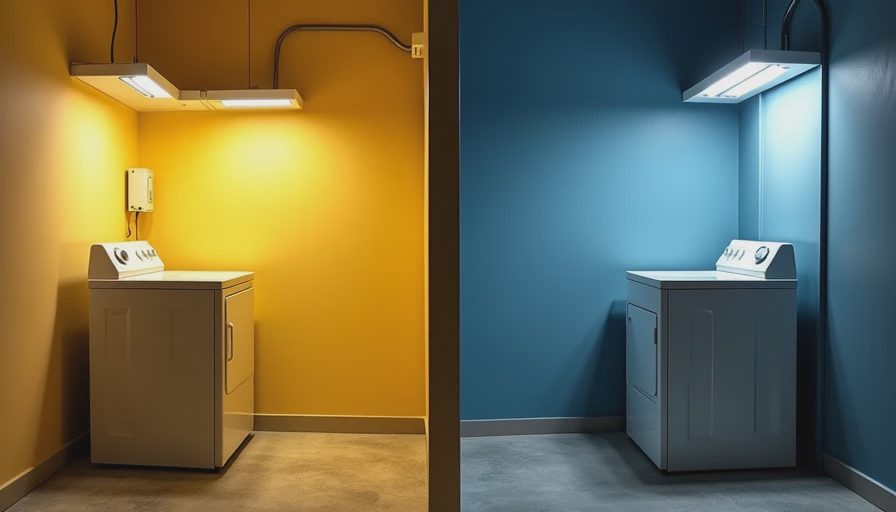
Color temperature matters more than most people think. Stay in the 3000K to 4000K range. Warm enough that the room does not feel like a hospital, cool enough that you can actually see dirt and stains. Avoid the yellow 2700K bulbs that make everything look dingy and the 5000K+ shop lights that feel clinical.
Brightness should be high enough that you can read a detergent label without squinting and inspect a shirt collar without carrying it to another room. In practical terms, aim for the equivalent of 100–150 watts of old incandescent light spread across the space, delivered by modern LEDs that use a fraction of the power.
Placement Beats Pretty Every Time
I have seen expensive pendant lights centered over a laundry room that still left the machines in shadow because the shade blocked half the output. I have also seen basic $30 LED shop lights that transformed the same footprint because they were long, bright, and positioned to kill the dark corners.
Mount fixtures so the light falls on the front of the machines and the counter surface, not just the top of the dryer. If you have tall cabinets or shelves, light the work surface separately. Motion sensors or a vacancy switch are worth the extra twenty dollars—laundry rooms are classic places where lights get left on for days.
If your laundry sits in a closet, consider a surface-mounted LED panel or a couple of bright puck lights. Closet laundry is already fighting limited space and limited air; it should not also fight limited light.
What We Did in the 1947 Basement
During the renovation we ran a new circuit and installed two simple 4-foot LED shop-light fixtures parallel to the machines, plus a short LED strip under the new open shelving. Total material cost was under $150. The difference was immediate. The room went from “get in and get out” to “I can actually see what I’m doing.”
We can now spot a lint buildup, a small drip, or a stain that needs pre-treatment without carrying items upstairs. Evening loads no longer feel like a forced march. The moisture meter still gets used, but the readings are better because we notice and fix small humidity sources earlier.
Lighting will not stop a hose from bursting. It will help you notice the early warning signs and make the daily work less unpleasant. Both matter.
The Quick Audit You Can Do Tonight
Walk into your laundry space at night with the current lights on. Can you clearly see the floor behind the machines? Can you read the fine print on a detergent bottle while standing at the washer? Are there dark corners where a slow leak could hide for days? Does the room feel like a place you would willingly spend twenty minutes folding clothes?
If the answer to any of those is no, the lighting is not finished. Fix that before you spend money on decorative storage or a new paint color. The room will feel larger, safer, and less depressing the moment you can actually see it.
A room you hate to be in is a room you’ll never take care of. Lighting is one of the fastest ways to stop hating it—and one of the cheapest ways to start taking better care of everything that happens inside it.