Twelve weeks after we started demo, the laundry room is finished enough to live with. The machines are in their permanent places. The floor is warm underfoot. The lights stay on when I need them. The water has somewhere to go if something fails. I still walk in there and notice the difference every single time.
This is the “after” post. Not the perfect magazine version. The real one, with the final cost, the things I would do again, the things I would change, and the daily experience of a room that no longer works against us.
The Final Number: $12,800
That figure includes everything that went into the laundry zone itself: framing, insulation, green board, flooring, plumbing rough-in and finish, electrical, lighting, the utility sink, the counter, the drain pan and sensors, paint, and the new machines. It does not include the larger basement work that happened at the same time or the value of my own labor on evenings and weekends.
Could we have spent less? Yes. We could have skipped the offset framing, used standard drywall, painted the concrete, and kept the old machines. The room would have looked better than the original bare-bulb corner and still been a future claim risk. We spent the money on the systems that prevent water and fire problems first, then on the surfaces that make the room usable every day.
What You See When You Walk In
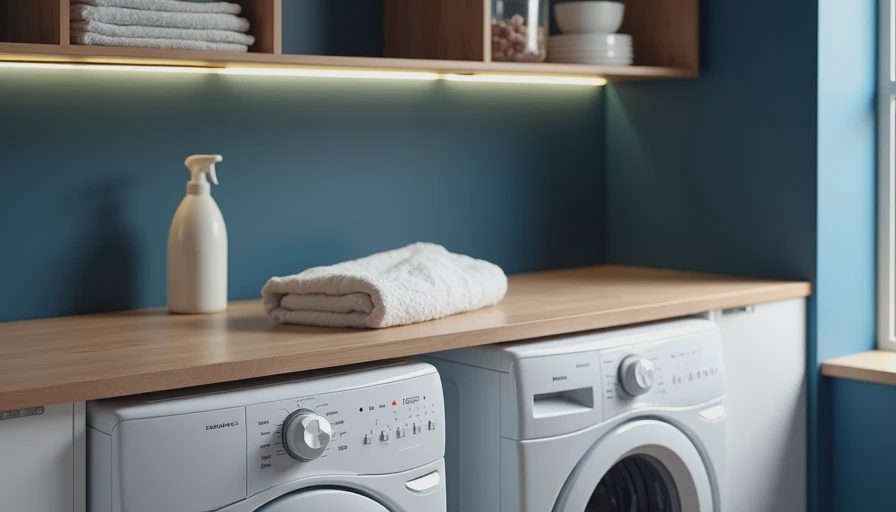
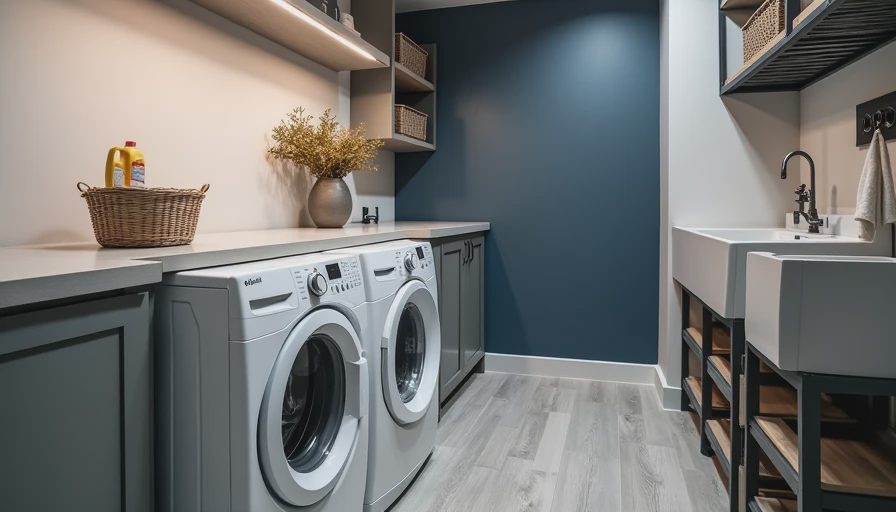
Side-by-side washer and dryer on a light-gray vinyl plank floor that pitches slightly toward a working floor drain. A continuous laminate counter runs over both machines with enough depth for a basket and a detergent bottle. Above the counter, open metal shelving holds the daily supplies. A deep plastic utility sink sits to the right with a real metal faucet. Two long LED shop lights and a short under-shelf strip keep the space evenly lit. The dryer vent is short, rigid, and easy to reach for cleaning. Braided stainless hoses and an automatic shut-off valve sit behind the washer where I can see them.
The walls are green board, painted a clean warm white. The foundation wall is no longer cold and exposed. The moisture meter readings along that wall stay consistently lower than the numbers we recorded before the work began.
What Changed in Daily Use
Evening loads no longer feel like a forced march. I can pre-treat a stain, measure detergent, and load the machine without balancing bottles on curved surfaces or walking upstairs. Wet gear from practice gets rinsed in the utility sink instead of the bathtub. Clean clothes have a landing zone. The floor is warm enough in January that standing to fold a few shirts does not feel like a punishment.
I still check the water sensor and the exterior dryer hood on a schedule. Old habits. The difference is that the room itself no longer generates new problems for me to find. The systems are quiet and competent. That competence is the real return on the twelve weeks and the $12,800.
What I Would Do Again Without Hesitation
Framing the wall off the foundation and insulating it properly
Installing a working floor drain and pitching the finished floor toward it
Using braided stainless hoses, reachable shut-offs, and an automatic water shut-off
Choosing rigid dryer duct with minimal elbows
Adding real, even lighting
Building a simple continuous counter over the machines
Those decisions address the exact failure patterns I used to see in claim files. They are also the decisions that made the daily work feel lighter.
What I Would Change or Skip Next Time
I would price a slightly deeper utility sink from the start. The one we have is good; a few extra inches of depth would have been better for large sports gear. I would also have ordered the countertop a week earlier—the only delay that actually stretched the schedule. Everything else landed close to the plan.
The Feeling That Matters Most
A room you hate to be in is a room you’ll never take care of. That line was the reason we started this project. The original corner trained us to rush, to ignore small issues, and to treat laundry as something to survive rather than manage. The finished room does the opposite. It is still a basement laundry space. It is not a spa. It is simply a room that supports the work instead of fighting it.
I do not love doing laundry. I no longer hate the place where it happens. That is the quiet victory after twelve weeks and $12,800. The machines run. The water stays where it belongs. The lights are on. The floor is dry. And when I walk downstairs at 9 p.m. with a basket of towels, the room is ready instead of resentful.
That is the after. It is enough.