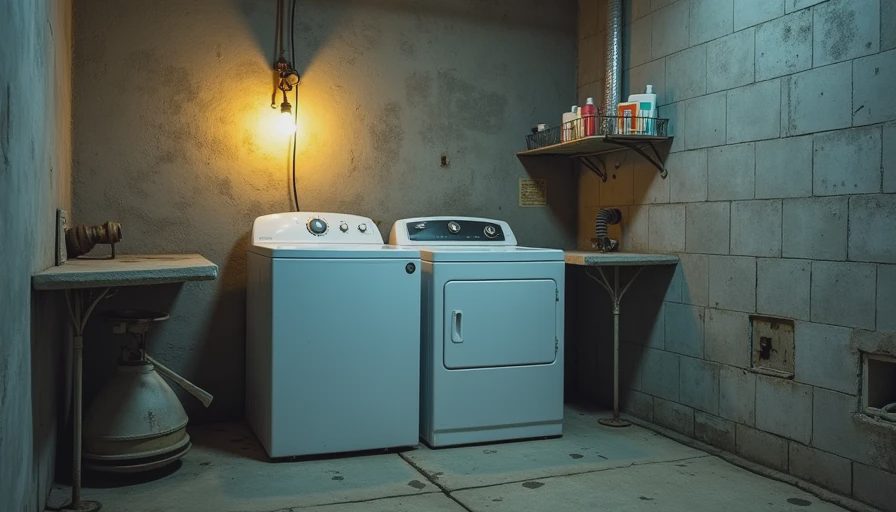
When Rachel and I bought the house in 2024, the listing photos carefully avoided the basement laundry corner. Smart move by the seller’s agent. What waited for us was a classic 1947 colonial special: washer and dryer shoved against an uninsulated foundation wall, one bare bulb on a pull chain, concrete floor that stayed damp from November through April, and a single rubber hose that looked older than some of the plumbing in the house.
No floor drain. No real lighting. No counter space. No ventilation beyond whatever air managed to drift up the stairs. The dryer vent was a crushed flexible foil tube that disappeared into the rim joist with no exterior termination we could find on the first inspection. The “storage” consisted of two wire shelves that sagged under the weight of detergent bottles and a stack of mismatched towels.
This is the unfiltered starting point. I’m sharing it because most laundry-room makeovers online begin with a space that already looks half-finished. Ours did not. If your current setup feels hopeless, you’re closer to where we started than you think.
The Exact Layout We Inherited

The laundry zone occupied roughly six feet by eight feet in the northeast corner of the unfinished basement. The foundation wall behind the machines was original parged concrete, cold to the touch even in summer. The floor was the original slab with a few cracks that widened every spring when the ground thawed. A single floor drain existed on the opposite side of the basement—about twenty-five feet away and slightly uphill. Water would have to climb to reach it.
The washer was a twelve-year-old top-loader that still ran but walked across the floor during the spin cycle unless we blocked the feet with scrap lumber. The dryer was a matching electric unit whose lint trap filled after every other load. Behind them sat a tangle of supply hoses, a rusty shut-off valve, and a power cord that had been extended with an orange outdoor-rated cable someone clearly never intended to leave in place.
Lighting was one 60-watt equivalent LED bulb in a porcelain socket. When it burned out, the only light came from the stairwell. We changed that bulb three times in the first winter because the cold and the vibration from the machines kept killing them.
What the Moisture Meter Already Knew
I brought the moisture meter down the day we closed. Readings along the foundation wall behind the washer sat between 18 and 22 percent in January. The rim joist above the dryer vent location hit 24 percent in one spot. The concrete floor near the machines never dropped below 15 percent even after a week of dry weather.
Those numbers are not catastrophic on their own, but they explain why the bottom of the wire shelving rusted out and why every cardboard detergent box eventually turned soft. Buffalo basements are humid by nature. Add a washer that vents warm moist air into the room and a dryer whose exhaust path is compromised, and the space becomes a slow-motion science experiment.
I took photos of every surface, every hose connection, every dark stain on the concrete. They are not flattering. That is the point. If you only ever see the “after” shots online, you start to believe your own space is uniquely terrible. It is not. Ours was ordinary for a house this age in this climate.
The First Things That Had to Change
We lived with the setup for six months while we planned the full renovation. During that time I replaced the rubber supply hoses with braided stainless steel on day two—non-negotiable after the claim files I had seen. I cleaned the dryer duct as far as I could reach and discovered the exterior termination had been covered by vinyl siding sometime in the 1990s. That got fixed the same weekend.
We added a battery-powered motion light so we could at least see what we were doing at night. We put a cheap plastic drain pan under the washer even though it had nowhere to drain; it at least bought us time if a hose let go. And I started a notebook of every decision we would reverse once the real work began: the location of the machines, the lack of a proper floor drain, the missing vapor barrier, the single circuit that also powered half the basement lights.
Living with the “before” for half a year taught me more than any Pinterest board. You learn which corners collect lint. You learn how cold the floor feels in February when you’re standing there folding towels. You learn that a room this unpleasant trains you to rush through the work and ignore small problems until they become large ones.
Why I’m Showing the Ugly Version
Most renovation blogs skip this part or shoot it with dramatic lighting and a wide-angle lens that makes the space look bigger and cleaner than it is. I’m not interested in that version. The value of this diary is the honest sequence: what we started with, what we refused to accept, what we spent money on, and what actually improved the daily experience.
If your laundry corner currently looks worse than the photos I’ll share in the next posts, good. You’re exactly the reader this site is for. The goal is not to shame anyone for having an unfinished basement. The goal is to show that a 1947 concrete corner with a bare bulb can become a room you do not dread walking into—and that the path starts with looking at the reality without filters.
Next week I’ll walk through the first demolition day and the moment we discovered a floor drain nobody knew existed. For now, this is the baseline. One bare bulb. One damp concrete floor. Two machines that worked hard in a space that worked against them.
A room you hate to be in is a room you’ll never take care of. We decided we were done hating this one.